
- Home
- High Commission
-
Consular Services
- E-Visa
- Issuing and Accepting Apostilles
- Visa
- Passport
- Registration of birth of a child and grant of Indian citizenship
- Renunciation of Indian Citizenship
- Overseas Indian Citizenship [OCI]
- Miscellaneous Services
- Consular Services Forms
- MADAD
- India has extended eVisa to Cyprus nationals for visiting India for tourism purposes
- Guidelines for Applicants for Registering Grievance
- Details of Death of Indians
- Advisory
- e-Clearance for Afterlife Remains eCARe portal
- India - Cyprus
- Tenders
- Media
- Contact
- NAMASTE CYPRUS
- ODOP
Speeches & Interviews
India – Cyprus Media Dialogue 2026
February 20, 2026
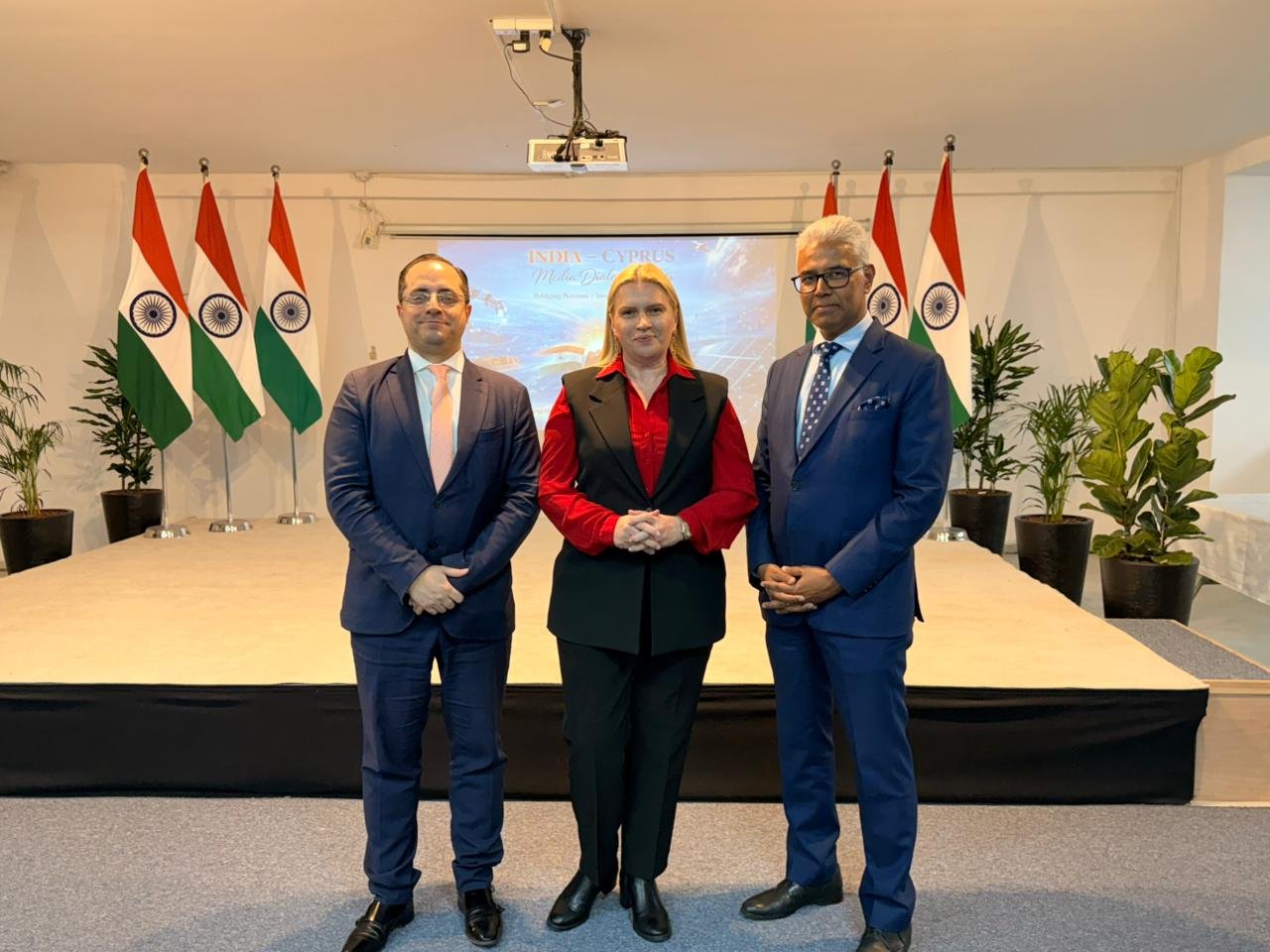
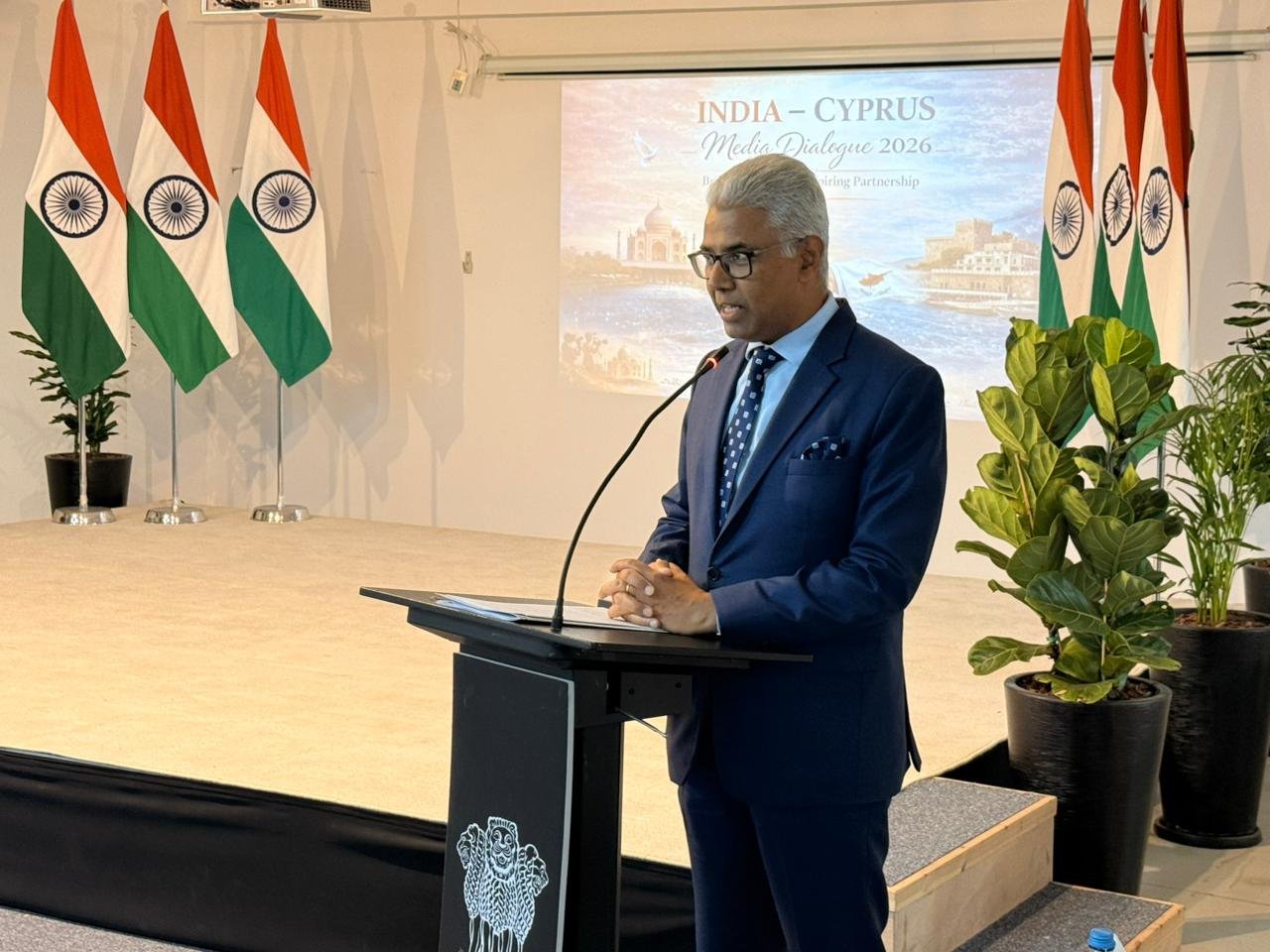
India – Cyprus Media Dialogue 2026
Address by the High Commissioner of India
- A very good evening to [Representatives of the Government of Cyprus], Distinguished Representatives of Media Organizations from Cyprus, Fellow Diplomats and Esteemed Colleagues, Ladies and Gentlemen,
- A warm welcome to all of you.
- It gives me immense pleasure to welcome you all to the “India–Cyprus Media Dialogue 2026”. This gathering of leading media organizations and journalists from Cyprus holds special significance, for it is the media - across print, broadcast, and digital platforms – that shapes public understanding and opinion of nations, peoples, and partnerships. Today, we have an opportunity to deepen the narrative of a partnership that deserves far greater visibility: the relationship between India and Cyprus.
- This dialogue comes close on the heels of India's Republic Day 2026 - a celebration held on January 26th at Kartavya Path in New Delhi, which this year carried particular historic resonance. For the first time, the European Union was represented at the highest level, with President of the European Council António Costa and President of the European Commission Ursula von der Leyen gracing the occasion as Chief Guests. Their unprecedented joint presence at India's Republic Day celebrations stands as a powerful symbol of the deepening India–EU strategic partnership - a partnership in which Cyprus plays a meaningful and growing role.
- India is among the world's fastest-growing major economies and is well-positioned to sustain this momentum. The World Economic Outlook Report of April 2025 pegged India, with a GDP of USD 4.18 Trillion, as the world's fourth-largest economy, surpassing Japan. In December 2025, the Reserve Bank of India revised India's GDP growth forecast for FY 2025-26 upwards to 7.3%, with GDP growth remaining persistently high despite global uncertainties.
- India's merchandise and service export performance in 2025 strengthened across major product groups and global markets. In FY 2025-26, India is expected to surpass 850 Billion USD in exports - its highest ever - beating 825 Billion USD of FY 2024-25. By strengthening trade partnerships with the United Kingdom, Oman, and New Zealand in 2025, India broadened its global export footprint. The first six months of Financial Year 2025-2026 saw FDI grow by 20%, from USD 33.5 Billion to USD 42.1 Billion. Inward remittances grew by 10% year-on-year. Sustained international confidence, robust domestic demand, falling unemployment, and easing inflation position India well to advance steadily towards its 2047 development goals.
- Driving India's growth engine is its dynamic startup sector - a story that has reached a significant milestone, marking ten years since the government's Startup India programme launched. Over this period, new-age companies have collectively raised approximately USD 151 billion across more than 25,000 funding rounds, establishing India as the world's third-largest startup ecosystem. The number of registered startups has grown from just 500 in 2016 to over 200,000 today. The revamped Startup India Seed Fund Scheme, the Atal Innovation Mission, and the Fund of Funds for Startups Scheme are now charting the course for the next decade with sharper execution and rigorous capital deployment.
- The Digital India revolution continues to transform governance. Everyone knows about UPI. But what lies underneath is a massive network of physical and social infrastructure. BharatNet has created 700,000 kilometers of optical fiber cables forming the core of India's total network of 4.2 million kilometers. India today operates half a million Common Service Centers, serving as last-mile access points for digital services. With 1.4 billion digital identities through Aadhaar and a tele-density of 131%, India has built a robust digital foundation. On this infrastructure rest India's digital successes – UPI for finance, DigiLocker for document management, CoWIN for vaccine administration, and GeM for procurement transparency. This digital public infrastructure has not only transformed governance but positioned India as a global leader in inclusive digital innovation, offering a model for developing nations worldwide.
- The year 2025 will be remembered as a landmark in India's defence journey. India achieved all-time high defence production of 15 Billion USD, marking an 18% increase from the previous year. More significantly, the private sector's contribution to defence manufacturing reached the highest ever figure of 23%, demonstrating the success of our indigenization policies.
- Our indigenous systems – Tejas fighter jets, BrahMos missiles, Akash air defence systems, advanced UAVs, and INS Vikrant, India's first indigenous aircraft carrier – are not just operational but most of these platforms are also being exported to over 100 countries. Defence exports have increased 35 times over the past decade, with projections to exceed 3 Billion USD worth exports by March 2026, moving steadily toward our ambitious target of 5 Billion USD by 2029.
- The approval of the Advanced Medium Combat Aircraft (AMCA) Programme Execution Model in May 2025 marks India's entry into the elite club of nations developing fifth-generation fighter aircraft. Our defence industrial corridors in Uttar Pradesh and Tamil Nadu, with investments exceeding US 9 Billion are creating over 52,000 jobs and establishing India as a global defence manufacturing hub.
- Operation Sindoor, launched in May 2025 in response to the Pahalgam terrorist attack that killed 26 innocent civilians, demonstrated India's military prowess and strategic resolve while validating years of investment in indigenous technology under Atmanirbhar Bharat. The operation sent an unequivocal message: India will not tolerate terrorism, and cross-border terror infrastructure will face decisive retaliation. India saw continued success in counter-insurgency operations, including Operation Black Forest in Chhattisgarh, bringing us closer to eliminating left-wing extremism by March 2026.
- India's space program reached new heights in 2025. Building on the historic success of Chandrayaan-3, which made India the first nation to land on the Moon's South Pole, and the Aditya-L1 solar observatory, India continues to expand its space capabilities. The approval of the Space-Based Surveillance programme with 52 satellites, including 31 to be launched by private Indian companies, demonstrates our commitment to public-private partnership in space technology.
- India's scientific institutions, particularly, the Center for Scientific and Industrial Research and the Defence Research and Development Organization delivered world-class technologies in 2025. CSIR developed the world's first port road using steel slag technology at Hazira, Gujarat, converting industrial waste into durable infrastructure. DRDO successfully tested the 'Sahastra Shakti' Laser Weapon, demonstrating India’s abilities at using directed energy capabilities for high precision strikes at UAVs and aerial threats.
- India's rise in global innovation rankings has been remarkable. In the QS World Future Skills Index 2025, India secured second place globally, showcasing leadership in AI and digital technology adoption. In the Global Innovation Index, India improved dramatically from 76th to 38th position – a testament to our focus on research, development, and innovation.
- The National Education Policy has brought transformative changes, with education now offered in mother tongues, recruitment exams conducted in 13 Indian languages, and over 10,000 Atal Tinkering Labs established in schools to foster innovation among children. The One Nation-One Subscription scheme provides free access to international research materials, enhancing ease of doing research.
- True to our constitutional commitment to equality, the government's welfare initiatives have particularly benefited our backward communities. India runs the world’s largest health assurance scheme, the largest financial inclusion scheme and a massive scheme for tribal villages focused on infrastructure, health and livelihood.
- Women empowerment has taken concrete shape, with the historic commissioning of 17 female cadets in combat roles in May 2025, reflecting the integration of women across all defence domains, breaking traditional barriers in one of the most male-dominated sectors. While the Lakhpati Didi initiative aims to enable 20 Million women in Self-Help Groups to earn a sustainable income of at least 100,000 Rupees per annum, Mission Shakti aims to revolutionize women’s safety and security in the country.
- India’s persistent interventions in the primary sector over the last decade have made it the largest producer of milk, the largest exporter of rice, milk, pulses, spices and jute, while also ranking in the top two in wheat, sugarcane, cotton, groundnuts and tea. India is also the world’s third largest domestic aviation market with 162 operational airports. In manufacturing, India’s National Industrial Corridor Development Programme has picked up speed with construction progressing at a hectic pace in key nodes like Krishnapatnam. More than 2.2 Million Electric Vehicles were sold in India by end of 2025. India’s private sector has welcomed the Government’s National Programme on Advance Chemistry Cell Battery Storage with the first 1GW Giga factory established in 2025. India exported 6.3 Million automobile units in 2025 growing by 24% over 2024. Today India has Metro rail systems in 26 cities. Our interventions in the Micro, Small and Medium Sector has strengthened this sector pushing their contribution to the country’s GDP to 30.1% which is a window into the remarkable diversification in India’s domestic economy.
- While India grows rapdily in urban infrastructure, heavy industries and manufacturing, we have not lost sight of nature and our environment. India ranks 3rd for the highest annual gain in forest area in 2025. For the first time in 45 years, in 2025, India recorded zero incidents of poaching of the Great One Horned Rhinoceros. India houses 3,800 tigers, 75% of the world’s population and India’s project Cheetah is expanding successfully with the population reaching 30 individuals with 19 new-born in India. Last but not the least, India achieved its target in sustainability early, with non-fossil fuel installed capacity crossing 50% in June 2025, five years ahead of the 2030 schedule.
- These achievements across economy, defence, technology, space, education, social welfare, and environmental sustainability reflect the successful realization of the transformative vision of Atmanirbhar Bharat – A Self-Reliant India. India's progress is not confined to isolated sectors but represents a comprehensive national transformation, positioning our nation as a responsible global leader committed to sustainable development, innovation, and inclusive growth.
- The year 2025 has been transformative for India–EU relations. The historic visit of the European Commission's College of Commissioners to New Delhi on February 27-28, 2025 — the first such visit outside Europe for the current Commission — elevated our partnership to new heights. President von der Leyen and Prime Minister Modi jointly announced the goal of expediting the conclusion of the Free Trade Agreement, with negotiations successfully closing in January 2026. In January 2026, India and the EU have also signed the landmark mobility pact to ease the movement of students and skilled professionals.
- The EU remains India's largest trading partner in goods, with bilateral trade at USD 135 billion in FY 2023-24 and EU FDI in India standing at USD 117.4 billion since 2000, representing 16.6% of total FDI. The EU has committed €1 billion for India's green hydrogen projects through the Global Gateway initiative. The presence of Presidents Costa and von der Leyen at Republic Day 2026 underscores the EU's recognition of India as a vital global partner and reflects our shared commitment to a rules-based international order, multilateralism, and sustainable development.
- The bonds between India and Cyprus are deep, historic, and rooted in shared values. Our relationship, established on February 10, 1962 — just two years after Cyprus gained independence — has been marked by mutual respect, solidarity, and cooperation.
- India supported Cyprus during its struggle for independence from British colonial rule, forging a friendship based on shared anti-colonial experiences. Since 1964, India has contributed three Indian Generals serving as Commanders of UNFICYP. Major General K.S. Thimayya, who died in service in Cyprus in 1965, was honored with a commemorative stamp and a road in Larnaca bearing his name. Symbolically, India's High Commission in Nicosia stands on Indira Gandhi Avenue, while in New Delhi, a major avenue honors Archbishop Makarios III – reflecting the deep personal and political bonds between our nations.
- India has consistently supported Cyprus's sovereignty, unity, and territorial integrity, advocating for a resolution of the Cyprus question through a bizonal, bicommunal federation as per UN Security Council resolutions. Cyprus, in turn, has been a steadfast supporter of India's permanent membership in an expanded UN Security Council and has stood with India on various multilateral forums.
- The year 2025 marked a watershed moment in India-Cyprus relations. Prime Minister Narendra Modi's official visit to Cyprus in June, the first by an Indian Prime Minister in over two decades, elevated our partnership to unprecedented heights. As you may have already seen, the announcement made by the President of the Republic of Cyprus, H.E. Nikos Christodoulides, in his message congratulating the Prime Minister of India, Narendra Modi, on the occasion of Republic Day, stated that he would undertake a bilateral visit to India in May 2026. We are looking forward to the visit of His Excellency to India and are in touch with stakeholders on both sides to prepare for his historic visit. The visit is taking place within a year of the Prime Minister’s visit, which shows the importance attached by both countries to our bilateral partnership.
- During this historic visit, Prime Minister Modi was conferred the Grand Cross of the Order of Makarios III, Cyprus's highest civilian honour. In his acceptance speech, the Prime Minister dedicated this award to the 1.4 billion people of India, describing it as a recognition of our shared values of peace, security, sovereignty, prosperity, and the philosophy of Vasudhaiva Kutumbakam, that is, the world is one family.
- The visit culminated in the signing of a Joint Declaration on the Implementation of the Comprehensive Partnership between Cyprus and India, outlining a Five-Year Joint Action Plan (2025-2029). This roadmap charts the course for expanded cooperation across defence, security, trade, investment, technology, innovation, maritime affairs, culture, and people-to-people ties.
- The visit of the Foreign Minister of the Republic of Cyprus, Dr. Constantinos Kombos's visit to New Delhi in October 2025 further strengthened this momentum, reviewing the Joint Action Plan and identifying concrete areas for immediate collaboration. The momentum continued with the visit of Ms. Annita Demetriou, President of the House of Representatives of Cyprus, to India in November 2025 – the first such parliamentary visit in three decades. In September 2025, Nicodemos Damianou, Deputy Minister of Research, Innovation and Digital Policy of Cyprus, led a high-level business delegation to India, participating in the ICC Global Business Summit in Mumbai. This visit focused on strengthening collaboration in technology, innovation, artificial intelligence, fintech, space technology, and digital services. I would like to draw your attention to the visit of the Deputy Minister of Research, Innovation and Digital Policy, Dr. Nikodemos Damianou, who was in India representing the President of the Republic of Cyprus at the India AI Impact Summit 2026, along with the Chief Scientist, Mr. Demetris Skourides, and a business delegation. Details about his visit are already in the Cypriot media. These high-level exchanges throughout 2025 transformed the India-Cyprus relationship from a traditional diplomatic partnership into a dynamic, action-oriented strategic collaboration.
- I am happy to inform you that the bilateral economic agenda has emerged as an important and prominent vertical of our partnership. This can be gauged from the number of activities, business events, and concrete outcomes that have taken place in the past year. Cyprus is one of the top ten countries through which India receives FDI. During the period 2020–2025, India received approximately USD 15 billion in foreign direct investment from Cyprus. Cyprus is also a Category-I country designated by the Indian regulator, the Securities and Exchange Board of India, for foreign portfolio investment.
- There is great opportunity for Cypriot fund managers to leverage this institutional provision, as well as the growth of the Indian economy, to invest in financial instruments. Already, key fund houses are operating from Cyprus and deploying capital in Indian markets. Prominent among them are Advent International, Resolute Global Partners, and Bao Capital Partners.
- In order to capitalise on and continue the momentum in the India–Cyprus economic corridor, the High Commission is organising a Business and Investment Summit on 3 March 2026. I would like to invite you to join this event. The theme of the event is “Transforming Tomorrow.”
- The Bilateral Defense Cooperation Programme (BDCP) 2026, was signed on 18th February 2026 in my presence, marking a significant step in our strategic partnership in the field of defence alongside an enhanced maritime cooperation framework.
- While bilateral trade averaged 140 – 160 Million USD annually, the focus in 2025 shifted to qualitative enhancement and future growth. A landmark MoU between NSE International Exchange at GIFT City and the Cyprus Stock Exchange enables dual stock listings, encouraging greater financial collaboration. The agreement between NPCI International Payments Limited and Eurobank Cyprus to introduce UPI for cross-border payments will revolutionize transactions for tourists and businesses, bringing India's world-leading digital payment infrastructure to Cyprus.
- Most significantly, the India-Greece-Cyprus Business and Investment Council trilateral platform aims to accelerate trade, investment, and strategic cooperation across infrastructure, shipping, technology, financial services, and SMEs.
- Recognizing people-to-people ties as a strategic asset, both nations are working to finalize a Mobility Pilot Program Arrangement and the Migration and Mobility Partnership Agreement, facilitating greater movement of professionals, students, and tourists. Cultural exchanges and tourism promotion remain priorities, strengthening the human dimension of our partnership.
- Cyprus's leadership role presents unique opportunities to optimally utilize the EU-India Free Trade Agreement and deepen collaboration in trade, technology, financial services, maritime transport etc.
- As India advances toward its vision of Viksit Bharat by 2047, a developed India marking 100 years of independence, this vision encompasses not just economic prosperity but social justice, environmental sustainability, technological advancement, and global leadership.
- The India-Cyprus partnership, now structured through a clear five-year roadmap, is poised to flourish. With Cyprus holding the EU Presidency in the first-half of 2026 and India strengthening its global engagements, our cooperation will contribute not only to bilateral prosperity but also to regional stability and global peace.
- We live in an age where perceptions shape policy, where narratives influence decisions, and where the quality of information exchanged between nations can make or break partnerships. It is here that the media plays a role that no diplomat, no trade negotiation, and no joint declaration can fully substitute.
- The India-Cyprus Media Dialogue is an investment in the foundations of our partnership. When Cypriot audiences read, watch, and hear more about India's transformation, its economy, its culture, its democracy, its challenges, and its aspirations, the relationship between our peoples deepens in ways that outlast any particular government or policy cycle. Equally, India's media ecosystem stands ready to tell the story of Cyprus, its resilience, its strategic position in the Eastern Mediterranean, its role in the EU, to 1.4 billion Indian readers, viewers, and listeners.
- I would encourage the distinguished representatives of Cyprus's media organizations gathered here today to consider: How do we make India a more familiar story for Cypriot audiences? How do we move beyond periodic diplomatic milestones to sustained, contextual coverage that helps citizens of both countries see each other as genuine partners?
- I am confident that today's dialogue will generate ideas, forge professional connections, and lay the groundwork for media collaboration, whether through joint reporting projects, journalist exchange programmes, media partnerships, or simply a commitment to cover each other's stories with greater frequency and depth.
- On behalf of the Government and people of India, I extend my sincere gratitude to all the media organizations and journalists from Cyprus who have joined us today. Your presence here is itself a statement of intent. I also thank all those who made this dialogue possible, my colleagues at the High Commission, and all who contributed to organizing this meaningful event.
- Let us use this platform well. Let us build bridges, between governments and economies, between the storytellers of our two nations. For it is stories, honestly and richly told, that will sustain and deepen the India-Cyprus friendship for the generations to come.
Thank you!